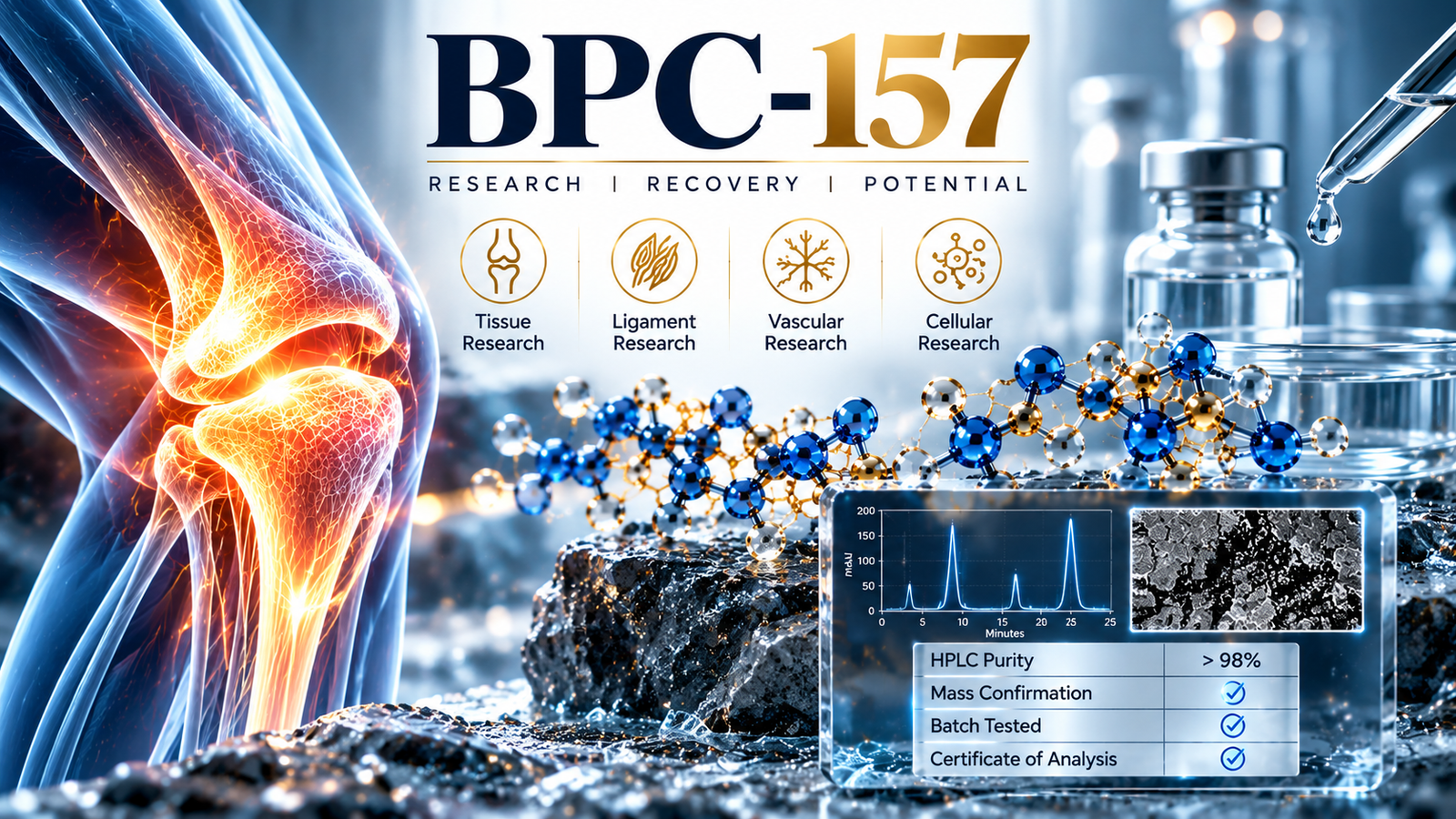
BPC-157 is a synthetic 15-amino-acid peptide that has attracted interest in laboratory research, particularly around tissue-injury models, tendon and ligament biology, gastrointestinal research and cellular repair processes. The strongest part of the published literature is preclinical research. Human evidence is still limited, so a useful research article should clearly separate experimental findings from proven clinical outcomes.
This guide is written for readers who want a simple explanation of what BPC-157 is, what researchers have studied, how to assess a research product and what the current evidence can and cannot tell us.
What Is BPC-157?
BPC-157 is a pentadecapeptide made up of 15 amino acids. Scientific papers describe it as a partial sequence associated with body protection compound research and investigate it in a range of experimental models.
The name is commonly searched alongside phrases such as BPC-157 peptide, BPC-157 research peptide, BPC-157 10mg and BPC-157 for laboratory research. These searches can refer to very different questions, so the first step is to identify whether the reader is looking for scientific background, product information or analytical documentation.
BPC-157 Research: Why Is It Being Studied?
The main research interest around BPC-157 comes from preclinical work. Researchers have examined its relationship with tissue repair, fibroblast activity, cell survival, cell migration and several injury models.
A 2025 systematic review of BPC-157 in orthopaedic sports medicine found a large preclinical literature covering musculoskeletal models. The review identified 36 relevant studies, with 35 being preclinical and one clinical study. That ratio is important: there is a substantial research base, but it is not the same as a large human clinical evidence base.
In simple terms, BPC-157 is scientifically interesting because laboratory and animal studies have produced signals worth investigating further. That is different from saying that a specific outcome is established in humans.
What Do Animal Studies Show?
One frequently cited study examined BPC-157 after Achilles tendon transection in rats. The researchers measured functional, biomechanical, microscopic and macroscopic outcomes. Compared with controls, the BPC-157 groups showed better measures of tendon recovery, including higher load-related measures and changes in fibroblast, reticulin and collagen formation.
Another line of research has investigated tendon fibroblasts and cell migration. Experimental work has reported increased tendon outgrowth, cell survival and migration in BPC-157-treated models. These findings provide possible biological mechanisms for further research.
It is important to keep the study model attached to the result. A rat tendon experiment tells researchers something about a rat tendon model. It does not establish that a human injury will respond in the same way.
BPC-157 and Tendon Research
Tendon healing is one of the most visible areas of BPC-157 research. Experimental studies have looked at tendon structure, mechanical strength, cellular activity and collagen-related changes.
The Achilles tendon study is useful because it did not rely on a single visual observation. Researchers used several types of assessment, including biomechanical testing and histological examination. This is stronger than an informal before-and-after photograph because the measurements are defined in advance.
For researchers reviewing the literature, the most useful questions are: What was the animal model? What was injured? What was the control? How was BPC-157 administered? How long was the study? Which endpoint changed? Was the difference statistically significant?
BPC-157 and Ligament Research
Ligament models have also been investigated. Experimental research involving medial collateral ligament injury in rats reported differences in functional, biomechanical, macroscopic and histological measures between BPC-157-treated groups and controls.
Again, these findings should be described as preclinical evidence. They help explain the scientific interest in BPC-157 but do not amount to a clinical recommendation.
BPC-157 and Cellular Research
Cell-based studies provide another way to investigate how a peptide might interact with biological processes. Research has examined tendon fibroblast outgrowth, cell survival and migration.
Cell studies are useful for mechanism-focused questions because researchers can isolate particular processes. However, a cell culture result does not reproduce the complexity of a living organism. It should therefore be treated as one evidence layer rather than a complete answer.
BPC-157 and Gastrointestinal Research
BPC-157 has also been investigated in gastrointestinal and mucosal models. This is one reason the peptide appears in research discussions outside musculoskeletal science.
The literature includes animal models examining mucosal injury and related biological responses. These studies are relevant to understanding the breadth of BPC-157 research, but they should not be converted into claims that the peptide is an established treatment for gastrointestinal disease.
What Human Research Is Available?
Human research is much smaller than the preclinical literature. A 2025 pilot study examined intravenous BPC-157 in two participants. The study was designed around safety observations and reported laboratory measurements and vital signs around the infusions.
The study’s sample size was only two people. That is far too small to establish effectiveness or broad safety. It is nevertheless relevant because it illustrates the difference between having some human data and having strong clinical evidence.
What Are the Research Benefits of BPC-157?
When the word “benefits” is used on a research page, it is better to describe the areas of research interest rather than promise a personal outcome.
- Research interest in tendon injury models.
- Research interest in ligament injury models.
- Research into fibroblast activity and cell migration.
- Research into collagen and connective-tissue responses.
- Research into gastrointestinal and mucosal models.
- Research into cellular repair and tissue-response pathways.
These points describe why scientists study BPC-157. They are not instructions for personal use and do not establish a medical benefit for an individual.
BPC-157 Before and After: What Does the Research Actually Measure?
Searchers often use “BPC-157 before and after” because they want to see a visible change. Scientific studies generally provide better evidence when they use defined measurements instead of photographs alone.
For example, tendon studies can compare mechanical load to failure, functional scores and tissue structure. These measures are more informative than a photograph because they can be collected using a defined method.
A before-and-after result is also stronger when there is a control group. Without a control, it is difficult to know whether a change came from the experimental compound, normal healing, another intervention or simple variation.
How to Compare BPC-157 Research Products
If you are comparing a BPC-157 research product, start with the product specification. Confirm the compound name, listed quantity, physical format and current storage information.
Then review the applicable Certificate of Analysis library. A useful CoA should be traceable to the material being assessed and should state the analytical information reported by the testing laboratory.
You can also use the guide to reading a peptide Certificate of Analysis when checking what a report actually tells you.
Why HPLC Results Need Context
HPLC is commonly used in analytical chemistry to separate components and assess chromatographic purity. A reported purity percentage can therefore be useful, but it is not a complete description of a material.
Identity and purity are different questions. Mass spectrometry, for example, can provide information about molecular mass and identity, while HPLC can provide chromatographic information. The exact methods and conclusions depend on the report.
For that reason, do not judge a research product only by the largest percentage printed on a page. Read the actual report.
Where Can I Source BPC-157 for Laboratory Research?
Researchers comparing UK suppliers can start by looking for clear product specifications and accessible batch documentation. Premium UK Peptides provides a BPC-157 10mg product page and a central Certificate of Analysis section.
The practical comparison is not simply “which website has the biggest purity number?” A better question is “which supplier gives me enough product and batch information to assess what is actually being supplied?”
Why Product Documentation Matters
A research article explains the science. A product page explains the material offered. A CoA provides analytical information about a particular test sample or batch. These three things should support each other without being treated as interchangeable.
BPC-157 10mg: What Should You Check?
For a listing described as BPC-157 10mg, check that the current product page clearly states the quantity and format. If a batch document is provided, match the batch or lot reference to the material being assessed.
Do not infer a formulation detail that is not stated on the current product documentation. If the supplier has not specified something, the safest research-writing approach is to say that it is not specified.
Frequently Asked Questions
What is BPC-157 used for in research?
BPC-157 is investigated in preclinical research involving tissue injury, tendon and ligament models, gastrointestinal models and cellular processes such as migration and survival.
Is BPC-157 clinically proven?
No. The published evidence is dominated by preclinical studies, while human research remains limited.
What does BPC-157 research show for tendons?
Animal studies have reported changes in functional, biomechanical and histological measures after tendon injury, including Achilles tendon models.
Is BPC-157 a healing treatment?
Research studies investigate possible biological effects, but preclinical findings should not be presented as a proven human treatment effect.
What is BPC-157 10mg?
It refers to a product listing containing a stated 10mg quantity of BPC-157. Always confirm the current product specification and applicable batch documentation.
How can I check a BPC-157 Certificate of Analysis?
Check the compound name, batch or lot reference, testing date, analytical method, reported result and testing laboratory details. See the CoA guide for a simple explanation.
Where can I find BPC-157 for laboratory research?
Researchers can compare suppliers by reviewing current product specifications and batch-level analytical documentation. The Premium UK Peptides BPC-157 product page is one option to review.
Does animal research prove the same effect in humans?
No. Animal and cell studies are useful for preclinical investigation but cannot by themselves establish a human clinical outcome.
Research Sources
- Emerging Use of BPC-157 in Orthopaedic Sports Medicine: A Systematic Review
- BPC-157 and rat Achilles tendon research
- BPC-157, tendon outgrowth, cell survival and migration
- Safety of Intravenous Infusion of BPC157 in Humans: A Pilot Study
Final Takeaway
BPC-157 is a research peptide with a broad preclinical literature, especially in tissue-injury and musculoskeletal models. The evidence is interesting, but it remains important to distinguish laboratory findings from established human outcomes. For researchers comparing products, the best starting point is a combination of scientific literature, clear product specifications and batch-specific analytical documentation.