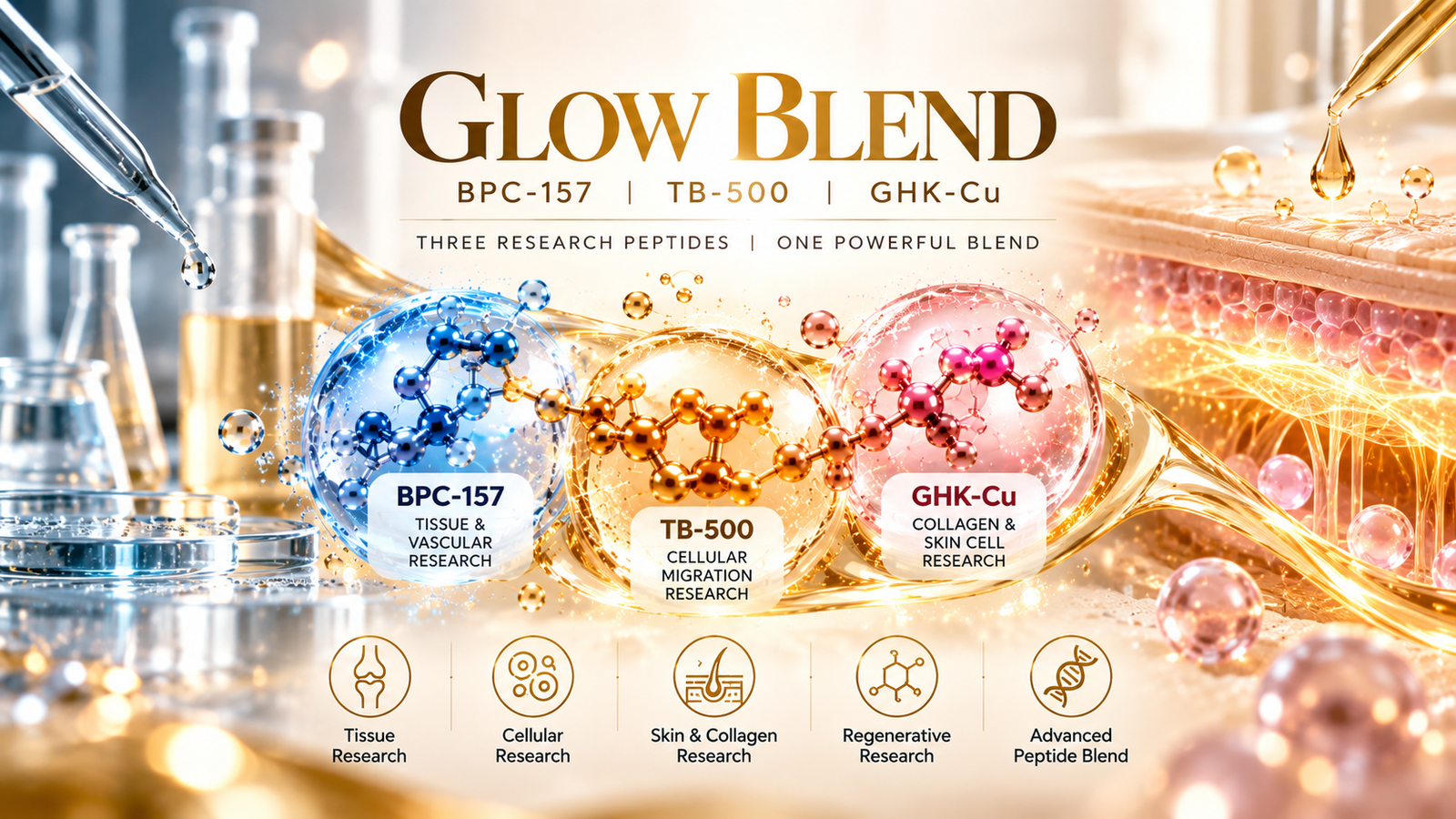
Glow Blend is a multi-peptide research formulation listed by Premium UK Peptides as containing BPC-157, GHK-Cu and TB500, with the supplied product information identifying the blend as 70mg. The scientific interest behind the three components is different, so the easiest way to understand the product is to look at each research area separately.
This guide focuses on research information, product-documentation questions and the evidence behind the individual components. It does not claim that research on one ingredient proves an effect for the complete blend.
What Is Glow Blend?
Glow Blend is presented as a combined research formulation containing BPC-157, GHK-Cu and TB500. The supplied product image identifies the product as “GLOW 70MG” and lists those three components.
The exact amount of each individual component is not stated in the product information supplied for this article. Because of that, this article does not invent a breakdown of the 70mg total. Researchers should use the current product documentation and applicable batch paperwork for product-specific composition.
Why Are These Three Peptides Studied?
The three components have different research histories.
- BPC-157: widely investigated in preclinical tissue-injury, tendon, ligament, gastrointestinal and cellular models.
- GHK-Cu: studied in skin biology, extracellular-matrix remodelling, fibroblast activity and tissue-repair research.
- TB-500 / thymosin beta-4-related research: investigated in cell migration, angiogenesis and tissue-repair models.
This gives the blend a broad research profile, but it also creates an important scientific limitation: evidence for the individual compounds is not the same as evidence for the finished three-component formulation.
BPC-157 in the Glow Blend
BPC-157 is the component with a particularly visible preclinical research history in tendon and tissue-injury models. A 2025 systematic review found 36 relevant studies in orthopaedic sports medicine, with 35 classified as preclinical and one clinical.
Animal research has reported changes in tendon structure, mechanical measurements and functional outcomes. One rat Achilles tendon study reported increased load-related measures and improved microscopic and macroscopic findings in BPC-157-treated groups compared with controls.
These findings explain the research interest but should remain labelled as preclinical evidence.
GHK-Cu in the Glow Blend
GHK-Cu is a copper complex of the naturally occurring tripeptide GHK. Research has examined its role in tissue remodelling, extracellular-matrix biology, fibroblast and keratinocyte activity, collagen-related processes and wound-repair mechanisms.
A published review describes a range of experimental effects associated with GHK and GHK-Cu, while newer evidence reviews continue to identify a gap between extensive mechanistic/preclinical evidence and the need for larger, well-designed human trials.
One randomized study investigated a topical copper tripeptide complex after CO2 laser resurfacing. Patient satisfaction was significantly higher in the GHK-Cu skincare group, while the study’s objective findings should be interpreted in the context of its design and endpoints. This is a good example of why a research article should distinguish subjective outcomes from objective measurements.
TB-500 and Thymosin Beta-4 Research
TB-500 is commonly discussed in peptide research alongside thymosin beta-4-related biology. Published thymosin beta-4 research has examined cell migration, angiogenesis, wound repair and connective-tissue organisation.
In a rat full-thickness wound model, topical or intraperitoneal thymosin beta-4 increased re-epithelialisation by 42% over saline controls at day 4 and by as much as 61% at day 7. The treated wounds also showed greater contraction, collagen deposition and angiogenesis. These were controlled animal experiments, not human treatment results.
Other research has examined thymosin beta-4 in dermal repair, including animal models and phase 2 clinical research. It is important not to assume that evidence from thymosin beta-4 studies automatically establishes the properties of every product marketed as TB-500.
How Does Glow Blend Combine BPC-157, GHK-Cu and TB500?
The basic idea is simple: three research compounds with different areas of scientific interest are presented together in one formulation.
BPC-157 research is strongly associated with tissue-injury and musculoskeletal models. GHK-Cu research is closely associated with extracellular-matrix and skin/tissue-remodelling biology. Thymosin beta-4 research includes cell migration, angiogenesis and wound-repair mechanisms.
That combination may be scientifically interesting as a research question. However, it should not be described as proof that the three compounds produce a specific combined outcome. To establish that, researchers would need studies using the exact formulation and defined endpoints.
What Are the Research Benefits of Glow Blend?
For a research-focused page, “benefits” can be explained as the scientific areas that make the ingredients interesting to researchers.
- Combines three peptides associated with different areas of tissue and cellular research.
- BPC-157 provides a research angle around tendon, ligament and tissue-injury models.
- GHK-Cu provides a research angle around extracellular-matrix and skin biology.
- TB-500/thymosin beta-4 research provides a research angle around migration, angiogenesis and tissue repair.
- The combination can be investigated as a formulation-level research question rather than relying only on single-compound literature.
Glow Blend Before and After: What Does the Evidence Tell Us?
“Before and after” is a popular search phrase, but photographs and personal reports are not controlled scientific evidence. For research purposes, the more useful data are defined measurements taken under controlled conditions.
For example, the thymosin beta-4 wound study reported numerical changes in re-epithelialisation at specific time points. BPC-157 tendon research has used biomechanical and histological endpoints. GHK-Cu research has used objective skin assessments alongside patient-reported satisfaction.
These examples show why evidence should be presented with the study design, model, sample size and measurement method rather than as a simple promise of a visible before-and-after result.
Does Research on the Individual Peptides Prove Glow Blend Works?
No. This is one of the most important points for anyone reading about a multi-peptide blend.
If a BPC-157 study reports a result in rats, that result belongs to that BPC-157 study. If a GHK-Cu study reports a finding in a topical skincare setting, that finding belongs to that formulation and study design. If a thymosin beta-4 study reports a wound-healing result, it does not automatically establish what a specific commercial TB-500-containing blend will do.
The exact finished combination needs its own evidence if a claim is being made about the combination itself.
How to Evaluate a Glow Blend Research Product
Start with the current product listing. Check the product name, stated total quantity, listed components, format and storage information.
Next, review the relevant Certificate of Analysis resources. If a batch-specific report is available, match its identifying information to the material being evaluated.
You can also use the site’s peptide CoA guide to understand common analytical terms.
Why the Exact Composition Matters
A total blend amount does not necessarily tell a researcher how much of each component is present. For example, a label showing 70mg total does not by itself provide the individual BPC-157, GHK-Cu and TB500 quantities.
That is why this article does not create an individual-dose breakdown. The current product documentation should be the source for exact composition.
HPLC, Mass Spectrometry and CoA Checks
HPLC and mass spectrometry answer different analytical questions. HPLC can be used to assess chromatographic purity, while mass spectrometry can provide information related to molecular mass and identity. A Certificate of Analysis can bring these reported results together for a particular tested sample or batch.
Researchers should look beyond a single headline percentage. Check the material name, batch or lot reference, test date, method, reported result and testing laboratory information where provided.
Glow Blend 70mg: What Should You Confirm?
The supplied product information identifies Glow Blend as 70mg and lists BPC-157, GHK-Cu and TB500. Before using this information in a catalogue or research record, confirm the current product page because product specifications can change.
Do not assume the 70mg total is evenly divided between the three peptides. Unless a current document states the individual quantities, the correct wording is that the total formulation is listed as 70mg and contains the three named components.
Frequently Asked Questions
What is Glow Blend?
Glow Blend is listed as a multi-peptide research formulation containing BPC-157, GHK-Cu and TB500, with the supplied product information identifying a total of 70mg.
What peptides are in Glow Blend?
The supplied product information lists BPC-157, GHK-Cu and TB500.
How much of each peptide is in Glow Blend?
The individual quantities are not stated in the product information supplied for this article. Check the current product documentation or applicable batch documentation for the exact composition.
What is BPC-157 researched for?
BPC-157 has been investigated mainly in preclinical models involving tissue injury, tendon and ligament biology, gastrointestinal models and cellular processes such as migration.
What is GHK-Cu researched for?
GHK-Cu has been studied in relation to skin biology, extracellular-matrix remodelling, fibroblast activity, collagen-related processes and tissue repair.
What is TB-500 researched for?
TB-500 is commonly discussed in relation to thymosin beta-4 research, where studies have examined cell migration, angiogenesis and tissue-repair mechanisms. Evidence for thymosin beta-4 should not automatically be treated as proof for a specific TB-500 formulation.
Is Glow Blend clinically proven?
No conclusion of clinical effectiveness for the exact Glow Blend formulation should be made from the individual-component literature alone.
Where can I find Glow Blend?
The current Premium UK Peptides Glow Blend product page provides the product-specific information to review.
How can I check the testing information?
Review the applicable Certificate of Analysis resources and match the report to the relevant product or batch.
Research Sources
- BPC-157 systematic review in orthopaedic sports medicine
- BPC-157 and rat Achilles tendon research
- BPC-157, tendon outgrowth, cell survival and migration
- Topical copper tripeptide complex after CO2 laser resurfacing
- GHK and tissue remodelling review
- Thymosin beta-4 wound-healing study
- Thymosin beta-4 dermal healing research
Final Takeaway
Glow Blend is best understood as a multi-peptide research formulation whose listed components have different scientific backgrounds. BPC-157, GHK-Cu and thymosin beta-4-related research each provide reasons for scientific interest, but the evidence for each ingredient should remain separate from evidence for the exact finished blend.
For researchers comparing products, the practical approach is simple: understand the published science, check the exact product specification, and review the applicable batch documentation rather than relying on a headline claim.